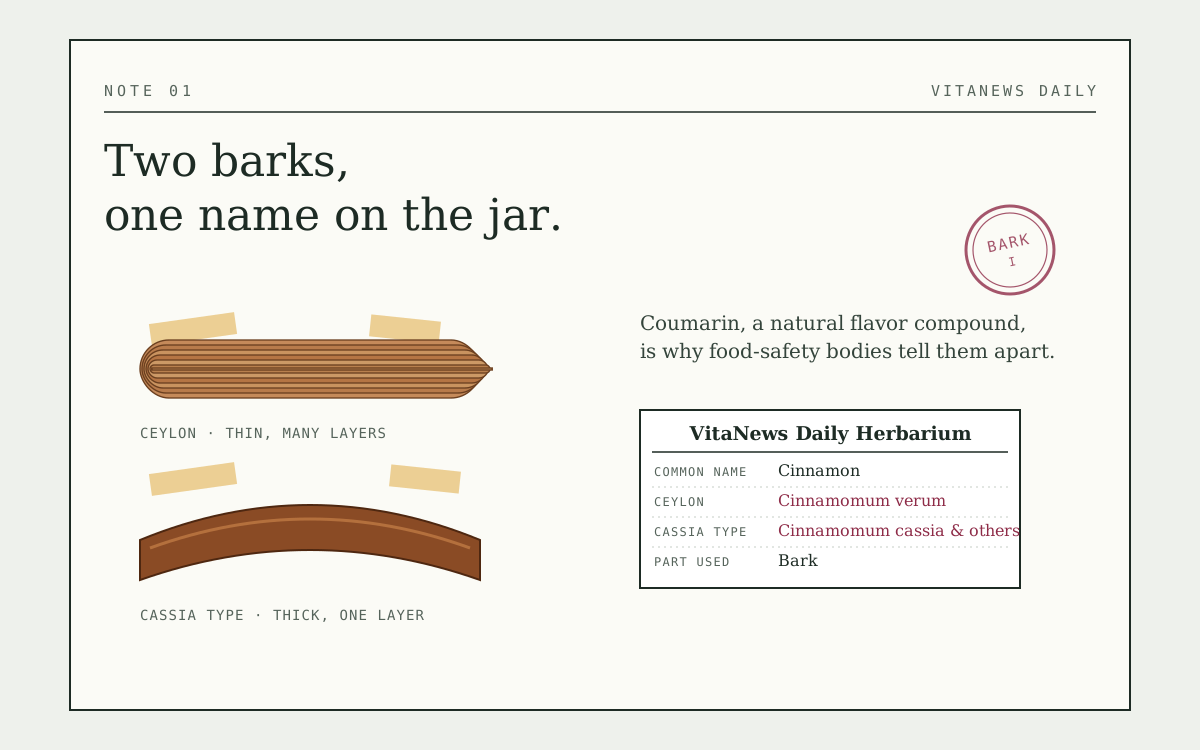
The short answer: most ground cinnamon sold in North America is cassia, and cassia contains noticeably more coumarin, a naturally occurring flavor compound, than Ceylon ("true") cinnamon. Germany's BfR does not tell people to avoid cassia. It recommends moderation, and it suggests that people who use large amounts of cinnamon often in home cooking choose Ceylon. The rest of this note explains where those positions come from and what the numbers look like at kitchen scale.
Two barks under one name
Cinnamon is the dried bark of trees in the genus Cinnamomum. According to the U.S. National Center for Complementary and Integrative Health (NCCIH), Ceylon cinnamon (Cinnamomum verum) is known as "true" cinnamon and grows primarily in Sri Lanka, while cassia cinnamon (Cinnamomum aromaticum) is grown in areas of southeastern Asia and is the most common type sold in North America.[2] In other references you will also see the older or alternative names C. zeylanicum for Ceylon and C. cassia for Chinese cassia.
"Cassia" is really a trade group rather than a single plant. A 2013 analysis from the University of Mississippi's National Center for Natural Products Research described "true cinnamon" as the dried inner bark of C. verum and noted that three other species, C. cassia, C. loureiroi and C. burmannii, are also sold in the United States simply as cinnamon.[3] On a supermarket shelf, the word on the label is usually just "cinnamon."
NCCIH also points out a practical problem for anyone reading research on cinnamon: products and studies often do not make clear which species, or which part of the plant (bark, leaf, root), was used, and those differences change the chemistry.[2] That is one reason this site's specimen sheets record the species only when the brand states it.
What coumarin is, and why regulators track it
BfR describes coumarin as a natural flavoring and fragrance substance found in many plants. It occurs in relatively high concentrations in the cinnamon types grouped as cassia, and also in woodruff, tonka beans and melilot. Synthetic coumarin, which smells of fresh hay, is used in cosmetics. Under EU rules, isolated coumarin may not be added to foods; it can only arrive as part of a plant ingredient such as cinnamon.[1] The 2013 U.S. study makes a parallel point for the United States: coumarin as an additive, or from tonka beans, is banned from food, while coumarin from other natural ingredients is not regulated.[3]
The reason for the attention is the liver. BfR explains that when coumarin was given as a medicine for a few weeks, even relatively low doses led to liver effects in a small group of especially sensitive people, ranging from raised liver enzymes to more serious reactions, and that these effects were usually reversible. In the same FAQ, BfR states that no such cases following the consumption of cinnamon had been described in the scientific literature.[1]
From that data, BfR derived a tolerable daily intake (TDI): the amount a person could take in every day for a lifetime without appreciable health risk. The figure is 0.1 mg of coumarin per kilogram of body weight per day, and BfR says it also applies to especially sensitive consumers. BfR adds that the European Food Safety Authority (EFSA) calculated the same value in its own assessment, and that exceeding the TDI briefly does not pose a health risk.[1]
A TDI is a lifetime, every-day benchmark with safety margins built in, not a line where harm begins. BfR says a slight excess for one to two weeks can be seen as safe, and that a health risk is possible only if someone eats very large amounts of high-coumarin cassia over an extended period.[1]
What the numbers mean at kitchen scale
The TDI only becomes concrete once you know how much coumarin is in the spice. BfR reports that food-monitoring data put cassia at roughly 3,000 mg of coumarin per kilogram of cinnamon on average (about 0.3% by weight), with the highest measured samples reaching around 10,000 mg per kilogram.[1] Using the average figure, BfR works through two examples:
| Person (BfR example) | TDI in coumarin | Average cassia that reaches it |
|---|---|---|
| Adult, 60 kg | 6 mg per day | about 2 g per day |
| Small child, 15 kg | 1.5 mg per day | about 0.5 g per day |
BfR also shows how far ordinary use sits from those figures. In its example, a small child who eats a main meal of rice pudding with 0.5 g of cassia twice a week reaches only 29% of the TDI.[1] The same arithmetic makes clear who the advice is really for: someone who stirs several grams of cassia into food every day, week after week, would sit above the benchmark, while occasional baking does not come close.
Two situations get separate attention in the BfR FAQ:
- Cinnamon-flavored foods. Since January 2011 the EU has set maximum coumarin levels for certain foods that contain cinnamon, such as 50 mg per kg for traditional or seasonal bakery goods labeled with cinnamon (cinnamon stars, for example) and 5 mg per kg for desserts. There is no EU limit for cinnamon sold as a spice.[1]
- Cinnamon capsules. BfR notes that cinnamon-based food supplements may contain high levels of coumarin, and that people taking cassia powder in capsules may exceed the TDI depending on the recommended dose.[1] This is a concentrated-product question, not a spice-rack one.
U.S. measurements point the same way. In the 2013 University of Mississippi study, authenticated C. verum bark contained only traces of coumarin, while all three cassia species contained substantial amounts, especially C. loureiroi and C. burmannii. Coumarin was detected in every locally bought cinnamon, cinnamon-flavored food and cinnamon supplement the team tested, and their chemical profiles indicated that the cinnamon in those samples was probably Indonesian cassia, C. burmannii.[3] The study measured contents; it did not assess anyone's intake.
How to tell which cinnamon is in the jar
BfR is candid that consumers can hardly tell Ceylon and cassia apart once they are ground. The reliable signal is the label: some products state "Ceylon cinnamon" on the packaging.[1] Sticks are easier. BfR describes a cassia stick as a relatively thick outer layer curled into a small roll, while a Ceylon stick, seen end-on, looks like a cut cigar: several thin layers rolled together into a densely packed quill.[1]
- Look for the word "Ceylon" or the binomial Cinnamomum verum (or C. zeylanicum) on the jar or the brand's page. If the label says only "cinnamon," assume nothing about the species.
- Read origin lines as the brand's statement. Sri Lanka is the main Ceylon source according to NCCIH, but an origin line on a jar is not proof of species on its own.[2]
- Check sticks by their cross-section: many thin layers rolled together suggest Ceylon; one thick curl suggests cassia.[1]
In our cabinet, the Frontier Co-op Ceylon cinnamon is sold under the Ceylon name, while the McCormick ground cinnamon jar says only "Cinnamon"; McCormick identifies it as cassia-type cinnamon in its own FAQ, not on the label. Each specimen sheet records exactly what the label and brand page state.
According to NCCIH, cinnamon is likely safe in the amounts commonly used in foods as a spice or flavoring; larger amounts or long-term use are sometimes associated with side effects, most often digestive upset or allergic reactions. NCCIH notes that interactions between coumarin in cassia and the liver have been reported, that ordinary cassia use doesn't usually supply enough coumarin to cause significant problems, but that prolonged use could be an issue for sensitive people, such as those with liver disease. NCCIH also says there are theoretical reasons to suspect some cinnamon components may interact with an anticancer medicine or nicotine, advises talking with a health care provider before using cinnamon products if you take any medicine, and considers larger-than-food amounts of Ceylon cinnamon unsafe during pregnancy. Never try the "cinnamon challenge" of swallowing dry powder; NCCIH warns serious harm is possible.[2]
Sources
- German Federal Institute for Risk Assessment (BfR). FAQ on coumarin in cinnamon and other foods: occurrence, tolerable daily intake, coumarin levels in cassia, EU limits for cinnamon-containing foods, and how to tell Ceylon from cassia. Updated FAQ dated 27 September 2012. bfr.bund.de
- National Center for Complementary and Integrative Health (NCCIH), NIH. Cinnamon fact sheet: species, background, research summary and safety. Last updated November 2024. nccih.nih.gov
- Wang YH, Avula B, Nanayakkara NP, Zhao J, Khan IA. Cassia cinnamon as a source of coumarin in cinnamon-flavored food and food supplements in the United States. Journal of Agricultural and Food Chemistry. 2013;61(18):4470-4476. PMID 23627682. PubMed
This note is educational and is not medical advice. Ask a clinician or pharmacist before using any herbal product regularly, especially if you are pregnant, nursing, have an existing condition, or take medication.