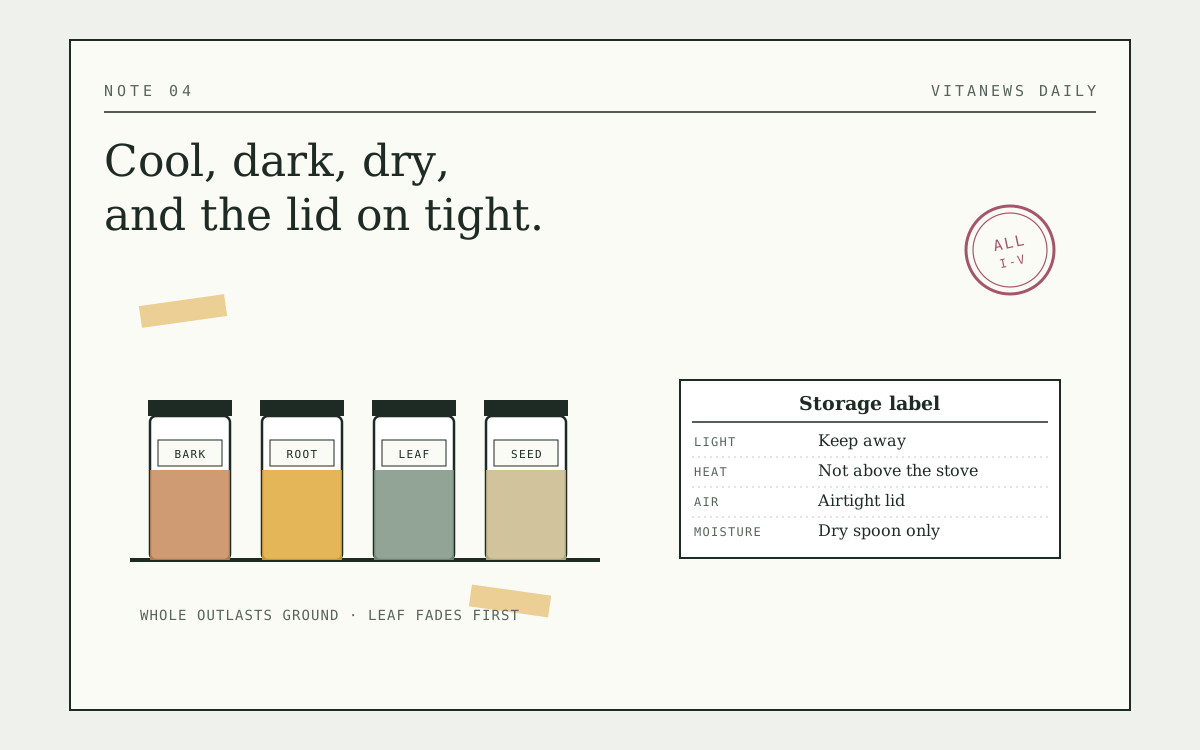
Keep dried herbs and spices in airtight containers, somewhere cool, dark and dry, and away from the stove. Buy whole where you can, grind or crush just before use, and check each jar's aroma and color every six months or so. That is the whole method; the rest of this note explains why it works and where the advice comes from.
What actually fades, and why
Oregon State University Extension explains that the flavor of herbs comes from oils in the plant's cell walls, which chopping or grinding breaks open. It also notes that crushing or grinding herbs and seeds for storage increases the loss of aroma and flavor, and that whole seeds and leaves keep longest while ground material keeps the shortest time.[3] In other words, grinding releases flavor at the moment you use it, and a ground spice sitting in a jar has already started losing it.
Four things speed the fading: light, heat, air and moisture. Penn State Extension advises storing spices and herbs in airtight containers in dry places away from sunlight and heat, and warns specifically that placing a spice rack above the stove quickly reduces the quality of those flavorings.[2] A Texas A&M AgriLife Extension handout goes further and lists spots to avoid: above the dishwasher, microwave, stove or refrigerator, and near a sink or heating vent.[1] The National Center for Home Food Preservation, based at the University of Georgia, gives the same core instruction for home-dried herbs: airtight containers in a cool, dry, dark area to protect color and fragrance.[4]
"Shelf life" for a dried spice is mostly about flavor, not safety. The Texas A&M handout puts it plainly: spices do not go bad like other foods; their shelf life is the time they are most aromatic and flavorful for cooking.[1]
Whole versus ground, leaf versus seed
The extension sources agree on the order in which things fade, even if their time frames differ:
| Type | Examples | Texas A&M guideline for home cooks |
|---|---|---|
| Whole spices | Peppercorns, whole allspice, caraway seed | 3-4 years |
| Ground spices | Cumin, ginger, paprika, chili powder | 2-4 years |
| Leafy herbs, ground or whole | Basil, oregano, rosemary, most blends | 1-3 years |
Those ranges come from a one-page handout that draws on a consumer shelf-life website and a spice company's guidance, and notes that professional cooks may say six months.[1] Other extension services are more conservative. Penn State suggests evaluating the freshness of ground spices and all herbs after six months, while noting that whole cloves, nutmeg and cinnamon sticks maintain their quality beyond two years.[2] Oregon State recommends using dried herbs within six months to one year for best flavor.[3]
The sensible reading is that the numbers describe how long a spice stays worth using, and that your nose is the final judge. What every source agrees on is the ranking: whole seeds and barks outlast ground spices, and dried leaves fade fastest. That is why a whole-leaf herb such as the Starwest rosemary keeps better if you crumble only what you need, and why ground spices such as the Spicely ground ginger are best bought in amounts you will use within months rather than years. Both the National Center for Home Food Preservation and Oregon State note that dried leaves can be left whole and crumbled as used.[3][4]
A simple storage routine
None of this needs special equipment. A cabinet or drawer away from the cooktop, jars with tight lids and a marker pen will do.
Buy whole and in sensible amounts
Choose whole peppercorns, seeds and leaves when a recipe allows, and buy ground spices in sizes you will use. Whole forms hold their flavor longest.[3]
Write the date on the jar
Penn State notes that labels give clues to shelf life and often carry storage information; add the date you opened the jar so the six-month check has a starting point.[2]
Store dark, cool and dry
Keep jars in a closed cabinet or drawer, away from the stove, dishwasher, microwave, sink, heating vents and sunny windows. An open rack works only if it sits away from heat, light and moisture.[1]
Keep air and moisture out
Close lids tightly straight after use and measure with a dry spoon so no moisture gets into the jar. Airtight containers are the common thread in every source we read.[2][3]
Grind or crush at the last moment
Crack peppercorns, crush seeds and crumble leaves just before they go into the pan.[3]
If you buy in bulk, the freezer is an option. Penn State says spices and herbs can be stored in the freezer to extend their shelf life, but advises bringing the container to room temperature before opening it, so that condensation does not form inside.[2] Oregon State also lists airtight freezer storage for dried herbs.[3] A practical approach is to freeze most of a large bag in sealed portions and keep one small jar in the cupboard for daily use.
How to tell when a jar is past its best
The check takes seconds. Texas A&M suggests that a spice or herb still doing its job should have a strong aroma, a pronounced taste and a vibrant color,[1] and Penn State advises replacing any spice or herb whose characteristic aroma has faded.[2]
- Smell: rub a pinch between your fingers (or crush a seed or leaf) and sniff. Faint or dusty means faded.
- Color: a vibrant color is a good sign; a dull, faded look suggests age. Comparing with a newly opened jar makes this easier.
- Taste: a tiny taste should be distinct. If you need to double the amount to notice it, the jar is past its best.
- Date: if a ground spice or dried herb has been open longer than the ranges above, give it the sniff test before using it.
Quality versus safety. Freshness is about flavor, but spice safety is a separate, supply-chain question. FDA's 2013 draft risk profile, updated in 2018, found Salmonella in spice shipments offered for import (fiscal years 2007 to 2009) at roughly twice the average rate of other imported FDA-regulated foods. FDA's later nationwide retail study found that prevalence in nine of 11 retail spice types was significantly lower than at import, consistent with industry reports that many spices receive a pathogen-reduction step after entering the U.S. FDA says it is not recommending that consumers change their use of spices, notes that heat during cooking can reduce contamination depending on time and temperature, and points to the basic food-handling steps: cook, chill, clean and separate.[5]
Storage changes flavor, not what a spice is. According to NCCIH, cinnamon is likely safe in the amounts commonly used in foods, with side effects sometimes associated with larger amounts or long-term use, and ginger has been used safely in many research studies of ginger supplements. NCCIH advises anyone who takes medication to talk with a health care provider before using herbal products beyond ordinary cooking, because some herbs and medicines interact in harmful ways. Ask a clinician or pharmacist if you are pregnant, nursing, or planning surgery.[6][7]
Sources
- Texas A&M AgriLife Extension Service. Storing Dried Herbs & Spices: one-page guidelines on storage locations, shelf-life ranges and freshness checks. Castro County Family and Community Health handout. agrilifeextension.tamu.edu (PDF)
- Penn State Extension. Storing Staple Ingredients in the Kitchen: section on spices and herbs. Updated August 9, 2024. extension.psu.edu
- Oregon State University Extension Service. Drying Herbs: storage of dried herbs, whole versus crushed. extension.oregonstate.edu
- National Center for Home Food Preservation, University of Georgia. Drying herbs: drying methods and packaging and storing dried herbs. nchfp.uga.edu
- U.S. Food and Drug Administration. Questions & Answers on Improving the Safety of Spices. Content current as of March 2, 2018. fda.gov
- National Center for Complementary and Integrative Health (NCCIH), NIH. Cinnamon fact sheet. Last updated November 2024. nccih.nih.gov
- National Center for Complementary and Integrative Health (NCCIH), NIH. Ginger fact sheet. Last updated February 2025. nccih.nih.gov
This note is educational and is not medical advice. Ask a clinician or pharmacist before using any herbal product regularly, especially if you are pregnant, nursing, have an existing condition, or take medication.