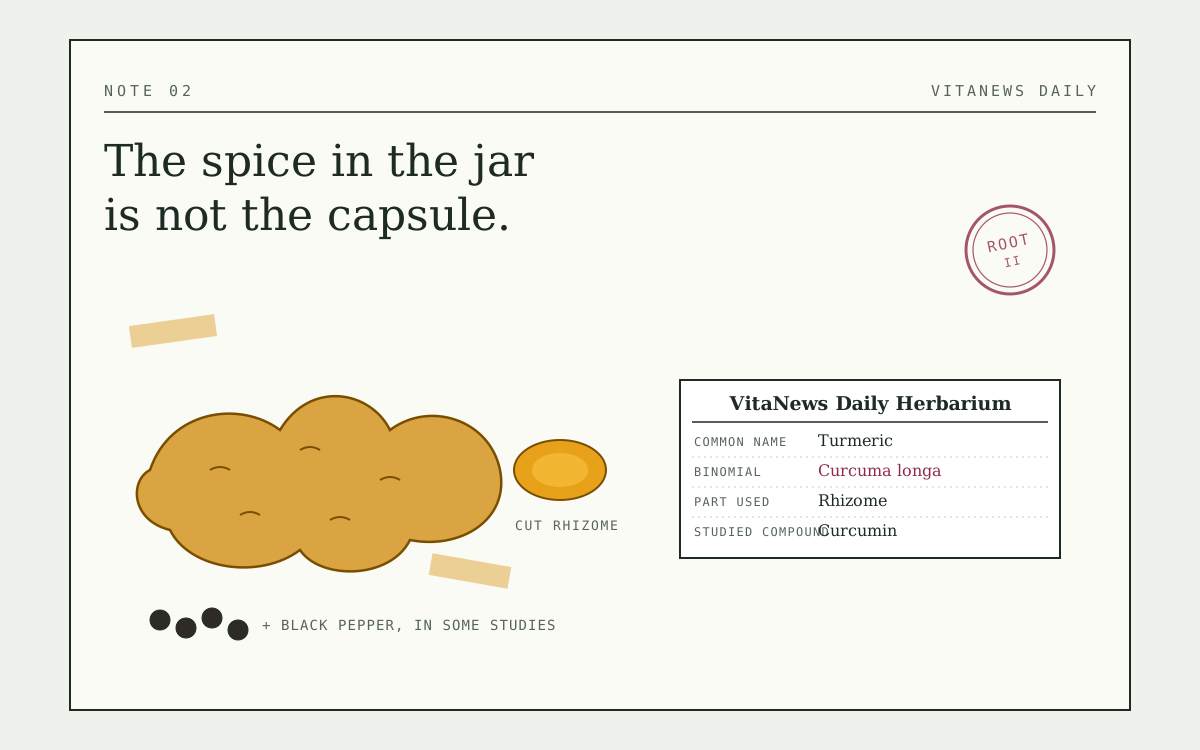
The plain answer first: when you cook with turmeric you are eating a spice that is only a few percent curcumin, and curcumin on its own is poorly absorbed. Most of the research people quote was done with concentrated curcumin products, often combined with piperine from black pepper or reformulated to raise blood levels. Those studies say a lot about capsules and very little about a pinch in a curry. Keeping the two apart is the single most useful thing to take from this note.
The spice and the compound
Turmeric is the rhizome (underground stem) of Curcuma longa, a plant in the ginger family. According to NCCIH, curcumin is a major component of turmeric and is what gives the spice its yellow color; the plant's studied activities are commonly attributed to a group of related pigments called curcuminoids, of which curcumin is one.[1] To make the ground spice, the rhizomes are processed, dried and milled; nothing is concentrated.
How much curcumin is in a jar? A 2006 laboratory analysis of 28 spice products sold as turmeric or curry powder found that pure turmeric powder had the highest curcumin concentration, averaging 3.14% by weight, while curry powders, with one exception, contained relatively small and highly variable amounts.[3] At that average, one gram of ground turmeric would hold roughly 31 mg of curcumin. Individual jars will differ; that figure is an average from one set of samples, not a label value.
Curcumin studies usually give hundreds of milligrams to grams of curcumin at a time. At about 3% curcumin, a 2 g curcumin dose corresponds to the curcumin in roughly 64 g of turmeric powder, far more than anyone uses in cooking. Research on capsules does not transfer to the spice jar.[3][4]
What "bioavailability" means in the studies
In pharmacology, bioavailability describes how much of a swallowed substance reaches the bloodstream, and for how long. Researchers estimate it by giving a dose and drawing blood at set times, then measuring peak concentration, time to peak, and the total area under the concentration curve. It is a measurement of exposure, not of any effect on how a person feels.
Curcumin scores poorly on those measurements. A widely cited 2007 review in Molecular Pharmaceutics attributed the low levels of curcumin found in plasma and tissues mainly to three things: poor absorption from the gut, rapid metabolism, and rapid elimination from the body.[2] Much of what is swallowed is changed into other compounds (in part by a process called glucuronidation in the liver and intestinal wall) before it circulates as free curcumin.[2][4]
The same review listed the main strategies researchers had tried to raise curcumin's blood levels: pairing it with an adjuvant such as piperine that interferes with glucuronidation, packaging it in liposomes, making nanoparticles, binding it to phospholipids, and designing structural analogues.[2] Many of these ideas now appear on supplement labels as "enhanced absorption" formulas. As the safety section below explains, NCCIH singles out that category for caution.
Where black pepper comes in
Piperine is the compound that gives black pepper (Piper nigrum) its bite. The study most often cited for turmeric-and-pepper pairings is Shoba and colleagues, published in Planta Medica in 1998. It was a pharmacokinetic study in rats and in healthy human volunteers:[4]
- In rats, curcumin was given at 2 g per kilogram of body weight, with or without 20 mg/kg piperine. Adding piperine raised bioavailability by 154%.[4]
- In people, a 2 g dose of curcumin alone produced serum levels that were either undetectable or very low. With 20 mg of piperine added, concentrations were much higher from 15 minutes to one hour after the dose, and the authors calculated a 2000% increase in bioavailability.[4]
- What it did not measure: any health outcome. It was a short dosing study of blood levels, with isolated curcumin in gram amounts and a measured dose of piperine.[4]
"2000%" sounds dramatic, but it multiplies a starting point that was close to zero, and it describes 2 g of pure curcumin, not a teaspoon of spice. Whether a grind of pepper over a turmeric-seasoned dish changes absorption in a meaningful way was not studied here. Pepper and turmeric simply taste good together, and that is reason enough to combine them in cooking. For how the peppercorns themselves are grown and processed, see the black peppercorn specimen.
NCCIH makes a related point about supplements: oral curcumin products vary in how much curcumin they actually contain and often include substances from other plants, such as piperine from black pepper, which is one way to improve curcumin's bioavailability. That variability is part of why NCCIH describes the evidence as hard to compare.[1]
Capsule doses and kitchen doses
European regulators give a sense of scale from the food side. The European Food Safety Authority (EFSA) re-evaluated curcumin used as a food additive (E 100, a yellow color) in 2010 and set an acceptable daily intake of 3 mg per kilogram of body weight per day. The panel noted that curcumin from the normal diet amounts to less than 7% of that figure.[5] For a 60 kg adult, the ADI works out to 180 mg of curcumin a day, which puts gram-level study doses in perspective.
A few practical ways to keep the categories straight:
- Ground turmeric in a jar is sold as a food, and the spice is what you are buying, not a measured amount of curcumin. See the Frontier Co-op turmeric specimen for a label read line by line.
- A curcumin capsule is sold as a dietary supplement, with a Supplement Facts panel that lists milligrams of extract per serving; many also add piperine or another absorption-oriented formulation.
- "Enhanced" or "highly bioavailable" wording signals a product built to raise blood levels well beyond what food provides. That is the category NCCIH flags for liver reports.[1]
- Research summaries should say which of these was tested. If a claim about "turmeric" traces back to a concentrated extract, it describes the extract.
As for the evidence itself, NCCIH's summary is restrained: many studies have been run, but there is not enough to definitively conclude that turmeric or curcumin is beneficial for any health purpose, and more research is needed to understand how bioavailability affects curcumin's effects.[1]
According to NCCIH, conventionally formulated oral turmeric or curcumin (not modified to enhance absorption) is likely safe in recommended amounts for up to 2 or 3 months, and can cause digestive side effects. NCCIH warns that highly bioavailable curcumin formulations may harm the liver: liver harm has been reported in some people who took them. NCCIH advises stopping turmeric or curcumin products and contacting a health care provider right away if you notice fatigue, poor appetite, dark urine, yellowing skin or eyes, or similar symptoms. NCCIH also says turmeric supplements during pregnancy may be unsafe, and little is known about larger-than-food amounts while breastfeeding. Ask a clinician or pharmacist before starting any curcumin product, especially if you take medication or have surgery planned.[1]
Sources
- National Center for Complementary and Integrative Health (NCCIH), NIH. Turmeric fact sheet: background, research summary, bioavailability and safety. Last updated April 2025. nccih.nih.gov
- Anand P, Kunnumakkara AB, Newman RA, Aggarwal BB. Bioavailability of curcumin: problems and promises. Molecular Pharmaceutics. 2007;4(6):807-818. PMID 17999464. PubMed
- Tayyem RF, Heath DD, Al-Delaimy WK, Rock CL. Curcumin content of turmeric and curry powders. Nutrition and Cancer. 2006;55(2):126-131. PMID 17044766. PubMed
- Shoba G, Joy D, Joseph T, et al. Influence of piperine on the pharmacokinetics of curcumin in animals and human volunteers. Planta Medica. 1998;64(4):353-356. PMID 9619120. PubMed
- EFSA Panel on Food Additives and Nutrient Sources added to Food. Scientific Opinion on the re-evaluation of curcumin (E 100) as a food additive. EFSA Journal, 2010, article 1679. doi:10.2903/j.efsa.2010.1679. Abstract consulted via an archived copy of the journal page. archived EFSA Journal page
This note is educational and is not medical advice. Ask a clinician or pharmacist before using any herbal product regularly, especially if you are pregnant, nursing, have an existing condition, or take medication.